Learn About Your Life . . . and Your Afterlife
The Afterlife Research and Education Institute has created apps with
- The most compelling evidence that you will live on after your body dies
- Proof that the end of this life is a painless, easy transition to the next life
- What everyday life in the afterlife is like
- How you can communicate with your loved ones in the afterlife
- What your personality style is and why you have conflict with people in your life
You can go through the apps at https://afterlifeinstitute.org.
The following sample is from the app with the proof you will never die. To see the whole app with 10 lessons full of evidence that you and your loved ones will live together in the afterlife, go to this link: https://youwillneverdie.afterlifeinstitute.org/
People Talk with Loved Ones Using Electronic Devices
A message from Dr. Hogan
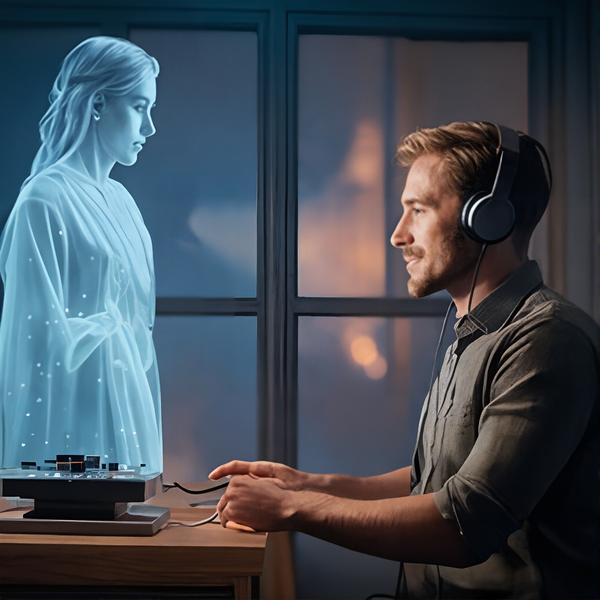
Instrumental Transcommunication, or ITC, is the name researchers give to communication received through ordinary electronic equipment — radios, tape recorders, telephones, and computers — rather than through a medium's own body or voice. For many people this is the most persuasive category of evidence in this entire course, because a machine has no expectations, no grief, and no motive to produce comforting fiction. It simply records what reaches it.
As you listen to these recordings, notice not just that a voice came through, but how directly it responded and how specific the details were. That responsiveness — captured by a machine with no motive of its own — is the heart of the case this lesson makes.
Sonia Rinaldi's Instrumental Transcommunication

Sonia Rinaldi is a Brazilian researcher who has spent decades refining methods of ITC, establishing communication with higher-level beings in the other realms of life who have worked with her to develop ways for us to receive images and recorded voices of loved ones now living in the afterlife. Her work has produced thousands of communications — voices speaking in multiple languages, including languages Rinaldi herself does not speak, responding directly and specifically to questions asked. She has also captured images on video that researchers have identified as recognizable faces of deceased individuals.
Sonia has dedicated most of her energy to helping parents connect with their children. Her sessions have resulted in as many as 200 recorded short messages from children to their parents who call in to communicate through Sonia. The volume and consistency of her results, and the conditions under which she works, have convinced many investigators that genuine communication is occurring. Her work is among the most extensive documented records of ITC in existence.
Sonia and the other instrumental transcommunication researchers record the voices of people living in the afterlife. They don't use the vocal cords they had when on Earth to speak. Their vocal cords are disintegrating in some grave somewhere. The vocal cords, breath, and mouth formation aren't necessary. The voices are actually magnetic tracks those in the afterlife have placed on the recording equipment. The tracks mimic the voice the people in spirit had when on Earth. They use their thoughts to project their voices into a device in the afterlife that they call "the box." Technicians in the afterlife then use the device to turn their thoughts into electronic tracks and lay them on a digital recorder or computer hard drive. When the tracks are played, the person's voice is heard. Even though the person is not speaking as in using a microphone, the voice is genuinely the person in the afterlife.
Here are some brief examples of her work.
Sonia asks the child in the afterlife whether he would like to leave a message for his mother.
Mommy, I Can Talk
Sonia:Would you like to leave a message to your mother?
Little girl:Mommy, I can talk.
A father speaks to his daughter. She responds.
A Father and Daughter
Father:I am sure you're doing great. We love you and miss you.
Daughter:Daddy, you know, love you.
Daughter:Miss my daddy.
Sonia asks another child in spirit what she would like to say to her parents.
Jasmine's Message
Sonia:Jasmine, what you would like to say to your dad?
Little girl:I love you.
Sonia:Say something beautiful to your mother.
Little girl:Miss you.
Sonia:What else you would like to say?
Little girl:Don't cry.
The author of these pages is Dr. R. Craig Hogan. Sonia Rinaldi did a recording in which she asked Craig's mother whether she would like to leave a message for Craig. Craig's mother knew Sonia's thought of what she was about to ask and answered before Sonia asked the question. The answers often are recorded just before the question. You'll hear the response, then the question.
A Message from Dr. R. Craig Hogan's Mother in the Afterlife
Craig's mother:Ready at this point.
Sonia:Can Mrs. Rosemary say something to Craig?
Sheri Perl's Instrumental Transcommunication

Sheri Perl came to ITC through personal grief — the loss of her son Danny. She began experimenting with recording techniques and found that she was capturing voices that responded directly to her questions, that identified themselves, and that demonstrated knowledge of personal matters. Her work has made ITC accessible to ordinary people — she has taught others to use these techniques and has documented their results alongside her own. The personal dimension of her work gives it a different kind of evidential weight: here is a grieving mother who set out to find her son and found, instead, the evidence that he was still there.
These are examples of the resulting recordings. Mothers of children in the afterlife called in to Sheri Perl to talk to their children. The children respond. You can listen to more recordings on Sheri's website at sheriperl.com.
Sheri Asks Her Son Danny, in Spirit to Say I Love You, Ma
Sheri:Danny, can you say 'I love, you Ma.'
Danny in Spirit:I love you, Ma.
A Mother Says "Hi" to Her Son in Spirit
Mother:Hi, Sweety
Son in Spirit:Hi Mom.
A Daughter in Spirit Assures Her Mother She's Fine
Mother:Alexandria, are you happy?
Alexandria:All the time.
A Son in Spirit Assures His Mother He's in Heaven
Mother:Are you in Heaven?
Son in Spirit:I am.
A Son in Spirit Responds to His Mother
Mother:Hi, Justin, it's Mom.
Child in Spirit:I speak English.
When researcher Sheri Perl first used Portuguese voice chopped up to create meaningless vocal sounds as background, she was not sure the speakers would be able to create English words, so she asked them whether they could speak in English. You will hear a child's response.
A Child in Spirit Responds, "I Speak English"
Sheri Perl:Say something in English to let me know I should use this.
Child in Spirit:I speak English.
George Meek and Bill O'Neil's Recorded Conversations with a Scientist in the Next Life


In the late 1970s, engineer George Meek and medium Bill O'Neil built a device they called Spiricom — an assembly of tone generators and radio equipment designed specifically to serve as a communication bridge. What followed became one of the most thoroughly documented electronic voice cases on record: extended, two-way conversations in which a voice identifying itself as Dr. George Mueller, a NASA scientist who had died years earlier, discussed technical details of how the communication itself was being achieved.

The communications were technically detailed, scientifically coherent, and specific in ways that were subsequently verified. Meek made all the recordings public and invited independent examination. The Spiricom experiments remain one of the most thoroughly documented cases of electronic communication with the deceased.
The Spiricom recordings
Why Is This Evidence Beyond a Reasonable Doubt of the Afterlife?
The proof in instrumental transcommunication rests on a simple but powerful fact: a machine has no motive, no memory, and no capacity for wishful thinking. When a device set up specifically to record produces a voice responding directly to a question just asked — in a language the researcher does not speak, using information the researcher has no way of knowing — the ordinary explanations (static misheard as words, coincidence, the researcher's own imagination) become harder to sustain the more specific and responsive the recordings are. This is exactly what made the earliest work in this field so significant: George Meek and Bill O'Neil built the Spiricom device specifically to serve as a communication bridge, and captured extended, technically coherent, two-way conversations with a voice that identified itself and discussed the workings of the device itself — details later verified independently, and made fully public for outside examination rather than kept private and unverifiable. Sonia Rinaldi's and Sheri Perl's recordings are not isolated, ambiguous fragments; they are extensive, repeatable bodies of work, gathered over years, in which children identify themselves, answer direct questions, and provide information their parents could verify. The evidence does not rest on any one recording, but on the pattern across thousands of them: independent researchers, using different equipment, in different countries, capturing voices that belong to someone who is still there, listening, and responding.
Reflection: If you had a recording of your loved one's voice responding to a question you asked — what would that mean for your grief? Take a moment to imagine it before moving on.
Technology can capture voices and images. But sometimes the deceased do not need technology at all — they simply appear, in full view, to people who know them. Our next lesson documents cases where deceased individuals were seen and spoken with by credible witnesses who were not in a séance setting but going about their ordinary lives.
Questions and Topics for Group Discussion
- Unlike a medium, a machine has no personality, no grief, and no motive. Does that change how you weigh the voices captured through ITC compared with the earlier lessons?
- Sonia Rinaldi's explanation of "the box" describes spirit voices as thought translated into electronic tracks rather than spoken sound. Does that explanation make the phenomenon easier or harder to accept?
- Several recordings in this lesson are brief — a few words from a child to a parent. Why might short, simple messages carry as much evidential weight as longer ones?
- Craig shared a personal recording of his own mother. How did hearing that personal example affect how you related to the rest of the lesson?
- George Meek and Bill O'Neil made all their Spiricom recordings public for independent examination. Why does that openness matter when evaluating a claim like this?
Explore Our Other Resources
Afterlife Communication Training — A free guided audio course teaching you to open your own connection with a loved one in the afterlife, with an 86% success rate. Begin the free introduction →
Personality Styles Test and Interpretation — A free 20-question assessment revealing your personality type and why you connect naturally with some people and clash with others. Take the free test →