This is a true story of a woman named Jean who had a remarkable touch from the afterlife. The names and details have been changed, but the events are real.
Jean lived on the top floor of an apartment building in Iowa. She was a nurse, and her hours were long and unpredictable. One evening, after a late shift, Jean came home to her apartment. She put her key in the door. The hallway was empty.
An Unexpected Visit
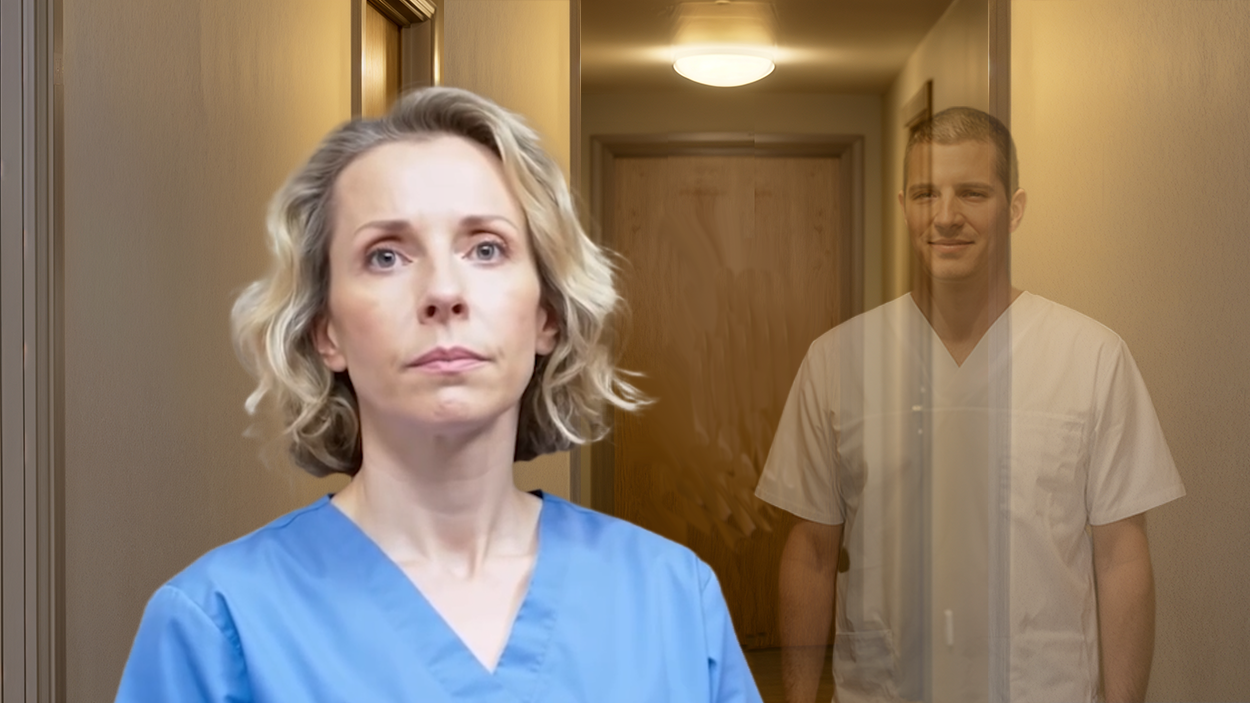
Before she could push the door open, she saw him. A young man, in his early twenties, stood at the end of the hallway. Twenty feet away. Dressed in white. Still. Smiling at her.
“Hello,” Jean said.
He said nothing. He only smiled and made a small gesture toward her.
Jean couldn’t tell what he wanted.
She stepped inside, closed the door, and set down her purse and keys. But she couldn’t stop thinking about him. She stood there for a moment, looking back at the door, wondering who he was.
Her Husband Appears Again
The next morning, Jean got ready for work. She picked up her purse and her keys, stepped out into the hallway, and locked the door behind her.
He was there again.
This time, he wasn’t just smiling. He was beckoning to her. Asking her to come. Jean hesitated. “What do you want?” she asked. “Can I help you?”
He beckoned again. Then he turned and walked toward the stairwell.
Jean followed. Carefully. Something about him felt urgent—like he needed help, even though he hadn’t said a single word.
She reached the stairwell. He was waiting at the entrance to the floor below, beckoning once more. She went down.
He led her down the hallway to a door. The second door. He gestured toward it—and then he stepped back. Jean noticed the door was open. Just a crack.
She pushed it open.
And there, on the floor, in a pool of blood, was a young woman. Her wrists had been slashed.
Jean didn’t hesitate. She grabbed the phone and called 911. Then she found towels — anything she could use — and bound the woman’s wrists, trying to stop the bleeding.
It felt like forever before help arrived. When it did, paramedics lifted the young woman onto a gurney, and wheeled her out to the ambulance.
Jean stood in the hallway afterward, shaken. She looked for the young man. He was gone.
She went back up to her apartment, washed the blood from her hands, and changed her clothes. She went to work as if an ordinary day was still waiting for her.
An Unexpected Reunion
Two days passed.
Jean was coming home from a shift at the hospital, waiting for the elevator, when a young woman approached. Jean recognized her instantly. The bandages on her wrists gave it away.
“How are you doing?” Jean asked gently. “I was with you — when you were on the floor.”
The young woman’s eyes filled with tears. She reached out and hugged Jean. “My name is Gail,” she said. “I can’t thank you enough. What I did was really stupid,” Gail said. “I was beyond grief. My husband died in a car accident last week.” We’d only been married for six months. I wasn’t… I wasn’t doing well.”
The elevator doors opened.
“I just don’t know what to do now,” Gail admitted.
“I might be able to help,” Jean said. “I’m a nurse. At the hospital.”
They got off together and walked to Gail’s door. Gail opened it, and they stepped inside. “I was so lucky you found me,” Gail said.
Jean paused. She wasn’t sure whether to tell Gail what had really happened. But she decided Gail deserved to know. So she told her about the young man in white, the one who led her down the stairs and to the door—and then simply wasn’t there anymore.
Jean told her, too, about the resources the hospital offered — people who could help her through the grief she was carrying.
As they talked, Jean’s eyes drifted to a picture on the table beside them. A wedding photo. And there he was. The young man from the hallway. Gail’s husband. Identical, in every way.
Suddenly, everything made sense. He hadn’t been a stranger wandering the halls that night. He had come back — from the afterlife — to save the life of the woman he loved.